Version of this project
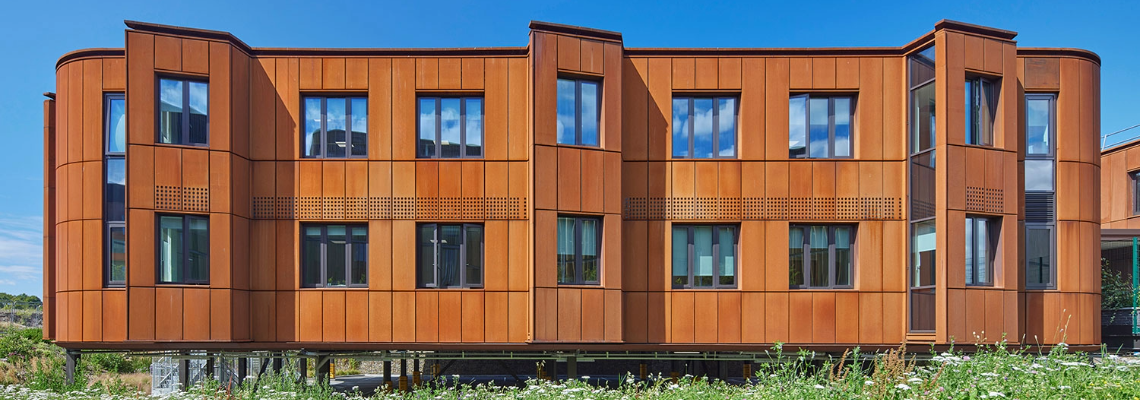


You're welcome! That's the message Catkin Centre and Sunflower House aim to convey at this hospital for children and young adults. This 3,000 m² project for Alder Hey NHS Foundation Trust in Liverpool unites various specialist mental health facilities, previously spread across the hospital and city, into two connected buildings using a Sylva kit of parts.
The 'home-from-home' for young people with complex and enduring mental health conditions includes a 12-bed inpatient mental health unit for children aged 5-13.
Because the centre provides outpatient services, including ASD, ADHD, developmental pediatrics, CAMHS, eating disorders and crisis care, there was a need for various types of spaces, including areas for engagement and interaction, quiet rooms, consulting rooms, family therapy rooms, art/music therapy, offices and meeting space.
Cullinan Studio Architects took an alternative approach to the traditional hospital typology by creating a series of cloistered routes around two courtyard buildings where clusters of consulting rooms, bedrooms and day spaces are gathered around a central outdoor garden.
The project received planning permission in November 2019, with a raised building over the car parking area, including drop-off and pedestrian access, set against a backdrop of garden terraces, to protect arriving patients’ privacy.
The external walls are clad in red-brown weathering steel panels that create a bright contrast with the surrounding greenery and sunlit bay windows.
Our UK partners, B&K Structures, delivered the cross-laminated timber (CLT), adding a layer of warmth and calmness throughout.
Designing with mass timber in healthcare buildings
Patients and staff of healthcare buildings understandably have higher levels of stress either as a result of illness or staff having to respond to life-saving situations. Over fifty studies have been published that strongly indicate that reconnect our connection to nature through the interior environment often has a stress-reducing effect, particularly for mental wellness, using nature-based architectural themes, including exposed natural wood.
Engineering and health professionals are furthering research into how mass timber, in particular as a construction material, can aid the design of healthcare buildings.
As far back as 1984, Roger Ulrich ran a study to measure the influence of natural and urban sceneries on patients recovering from gallbladder surgery. Some patients were provided with views to nature, whereas others looked at brick walls. With all other variables equal, the findings revealed accelerated recovery rates and reduced stress for the patients who had views of nature. On average, patients whose windows overlooked a scene of nature were released after 7.96 days, compared with 8.71 days for patients whose views were of the hospital’s exterior walls—a decrease of 8.5% (Ulrich, 1984).
Economic benefits of biophilic designs for hospitals
Breaking down this study into economic terms yields a significant cost reduction to the patient and the hospital at large. According to the Agency for Healthcare Research and Quality, the average expenditure per diem for a hospital stay after surgery in 2004 was $5,059 US/ approx. 4,000 GBP (Machlin & Carper, 2007). Applied to Ulrich's study of 46 patients, the cost of patient care could have been reduced by over $161,000/120,100 GBP if patients were released just one day sooner. While this is not a hard and fast calculation of cost savings, it speaks to the general magnitude of savings that a biophilic-designed hospital might be able to achieve.
Along both sides of the new buildings, the bedrooms and consulting rooms have projecting bay windows offering 'child-sized' refuge spaces looking towards the new park. The increased daylight has health benefits for the patients and staff but also contributes to the lower energy consumption of the building.
Hygiene of exposed and untreated wood in healthcare facilities
Research has shown that untreated wood materials have antimicrobial properties against a wide range of pathogens responsible for healthcare-associated infections. The most common microbes, including the SARS-CoV-2, survive least on porous materials as compared to smooth solid materials. There is demonstrated evidence that the cleanability of wooden and non-wood surfaces is comparable.
Catkin Centre and Sunflower House embrace this therapeutic principle by using naturally exposed cross-laminated timber and incorporating areas of refuge around courtyard gardens, creating an inviting environment with strong connections to natural materials and systems
The exposed Sylva™ CLT elements also contribute to healthy indoor air quality and are M1-classified, meaning they emit low levels of volatile organic compounds.
Environmental performance data
Percentage of floor area with daylight factor >2% Approximately 6.5%
Percentage of floor area with daylight factor >5% Approximately 80%
On-site energy generation Part of site-wide CHP plant (building future-proofed for solar/solar thermal systems)
Airtightness at 50Pa 5 m³/h.m²
Heating and hot water load 15.55 kWh/m²/yr
Overall area-weighted U-value Wall 0.18 W/m²K, floor 0.15 W/m²K, roof 0.25 W/m²K
Design life 60 years
Annual CO₂ emissions 25.8 kgCO₂eq/m² (Source Architects' Journal)
Carbon footprint of materials provided by Stora Enso
Manufacturing 33 tonnes CO2e = greenhouse gases
Advantages with Sylva™
479 tonnes CO2 were removed from the air and stored in the hospital
718 tonnes CO₂e emissions avoided by using wood instead of non-renewable construction materials
Read more:
RIBA Journal: Juvenile mental health: how to be welcoming and secure
Hygienic Perspectives of Wood in Healthcare Buildings
How replacing concrete with timber can save costs, reduce carbon and make for better buildings
Health and wellness benefits with wood.
View more health care facilities built with Sylva™
| Area (m²) | 3,073 |
| Products and Services | Sylva™ CLT Floors and Roofs, Sylva™ CLT Walls |
| Product quality | PEFC certified | Visual surface INV & VI | Sylva360 | Preinstalled lifting slings |
| Product volume (m³) | 628 |
| Partner of Stora Enso | B&K Structures |
| Developer | Alder Hey Children’s NHS Foundation Trust |
| Architect |
Cullinan Studio Delivery architect 10architect (post Stage 3) |
| Structural Engineer |
Scott Hughes (post Stage 3) Buro Happold (up to Stage 3) |
| Main contractor | Galliford Try |
| Total construction development cost (€) | 24,000,000 |