Version of this project
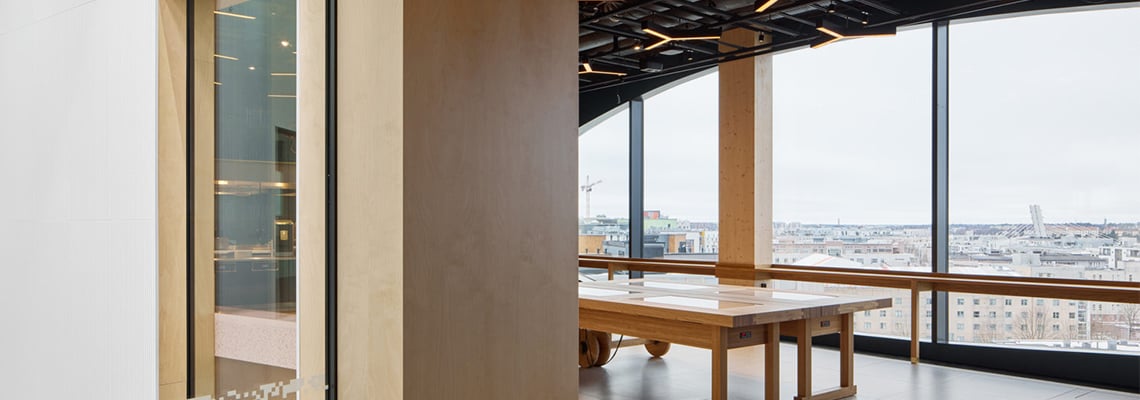

The wooden block in Jätkäsaari, Helsinki, is an example of large scale wooden urban building. Since January 2021, the office building has been occupied by the mobile game company Supercell.
The building’s ground floor, basement, elevator shafts and stairwells are made from concrete and floors 1–6 are made with wood.
Finland began working to increase their domestic wood industry around thirty years ago. Rules on how high you could build in wood were amended to allow for a greater variety of designs. Later more focus was centred on greenhouse gas emissions which further intensified the demand for wood construction.
In 2012, Finland's leading property developer, SRV and Stora Enso joined forces with the City of Helsinki and a competition was launched to build an entire city block from mostly solid wood which at the time would be the biggest in Europe.
Today there are many examples of skyscrapers made with Finnish wood including Mjøstårnet, Norway (18 floors), Lighthouse Joensuun (14 floors), Moholt 50|50 (9 Floors) and as well as landscrapers occupying immense areas such as Stora Enso's head office, Katajanokan Laituri also in Helsinki (23,000 sq. m).
The first part of the competition involved drawing up a city plan for the development, following the terms of the design brief. 'Mostly in wood' meant a hybrid structure where load-bearing elements such as lift shafts would still be concrete to handle the heavy wind loads in the coastal location, but the posts, beams and floors would be made of wood.
The competition was won by Helsinki practice Anttinen Oiva Arkkitehdit (AOA), with their five-cornered, elongated buildings opening onto a calm and leafy inner courtyard. First to be built were the apartment blocks for the City of Helsinki's housing company. One of the blocks was then earmarked for offices. The competition brief also stated that there should be an exhibition space for Finland's wood industry on the ground floor.
The lower ground floor is transparent and open, with glazing providing views inside. Inside the architects designed an exhibition space in wood, with curves and waves that create the feel of the cave. In the end, the showroom for wood never happened, and the space is now a lobby and exhibition space for the office building, but is still a stunning showpiece especially for those interested in wood construction. AOA described it well when he said it is 'a special, abstract place with a great atmosphere, like watching an open fire or sitting in the forest - it's calming.'
In 2016 Supercell, a leading games development company, became interested in the project. They began by leasing the upper half of the building as offices, but as the company expanded, employee numbers grew and they needed more space. In the end they decided that they wanted to buy the whole building. Supercell has very specific needs. To be able to compete internationally and attract the most qualified people in the world, Supercell wanted to create the best possible working environment for its employees. Wood was the perfect material as it creates and a warm and homely atmosphere. They also needed a technically high-performance building. In simple design terms this meant a major rework with fewer columns and more space between the floor and ceiling panels to place cabling.
Changes in the team space layouts in December 2018 were the single biggest change. This totally transformed all the interior structures and the systems the users wanted, all while the concrete framework was already being poured. To support the design work and to test the user experience, a 1:1 scale model of a team space was created for the project. This made it possible to test different technical, structural and surface material options.
Rib Panels
In collaboration with SRV, Stora Enso and consultancy firm Sweco, the architects developed new beams, columns and floor slabs to make this possible. CLT was initially used in the designs, but over the course of the project Stora Enso developed a new material, laminated veneer lumber (LVL) Rib Panels which they used instead. Structures with longer spans can be achieved using LVL so they could remove remove a row of posts around the whole building, which in turn created more open spaces.
Zero accidents
Occupational safety received special attention right from the project's planning stage. As there was very little room to maneuver on the site, careful planning was required to ensure safety not only on the site itself but also for other operators nearby. The accident rate for SRV on the site was zero. The average for the entire site was 17.88, which can be considered to be a good result considering the 1.9 million hours worked.
The site particularly excelled in making safety observations. A total of 1,278 observations were made in 2019, which is the highest across all SRV construction sites. Safety gates were conducted once a week by SRV's management.
Moisture management
For moisture management, the project team worked with leading experts to develop a detailed moisture management plan for the construction phase.The intermediate floor elements were sealed, the edges were dammed up, and rainwater was directed down from the top vault via rainwater channels. When the frame was put up, critical wood frame materials (façade elements, load-bearing LVL elements) were stored with their moisture-sensitive parts protected. Façade installation work overlapped with the installation of the frames. In other words, a façade was installed for each floor as soon as the floor above it was completed.
As part of their initial training, every employee on site went through a separate moisture management session to ensure they understood the basics and importance of moisture management. Separate moisture management rounds were conducted weekly, and the results were reported directly to the Helsinki Building Inspectorate.
Learn more about moisture protection for wood construction.
Publications
Significant interest drawn from around the world Wood City is a unique ensemble, even on a global scale. The site has stirred up significant interest, with delegations from dozens of countries around the world coming to visit. Watch the video about the construction here.
Watch more about this project on the BBC and Why Finland is building in wood on the B1M
Read about this project in PuuInfo
Learn more about the sustainability achievements of this project on their LEED scorecard
| Area (m²) | 13,883 |
| Storeys | 8 |
| Products and Services | Rib Panels, CLT, LVL |
| Product volume (m³) | 1,900 |
| Product delivery duration (weeks) | 18 |
| Number of deliveries | 80 |
| Developer | Supercell |
| Architect | Anttinen Oiva Arkkitehdit Oy |
| Structural Engineer | Sweco Rakennetekniikka Oy |
| Main contractor | SRV Rakennus Oy |
| Specialist Timber Subcontractor | Turun Elementtiasennus Oy |
| Timber superstructure erection duration (weeks) | 18 |