Version of this project
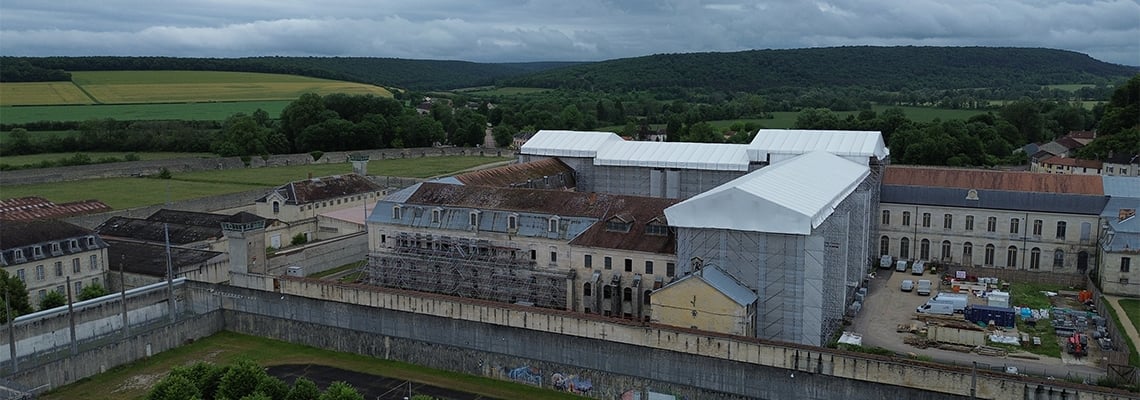
Clairvaux Abbey, in the Champagne region of France is a Cistercian monastery. Founded in 1115 by Saint Bernard and then completely modernised by the monks in 1708, the Abbey of Clairvaux finally became a prison in 1808. The Ministry of Culture took over the administration of the Abby and launched a tender for several sub-parts to initiate the overall renovation of the site. One of the first was to restore the structures and roofs of the Grand Cloître. The initial € 13 million phase of the restoration of the structures and roofs of the Grand Cloître are now underway.
Extraordinary project
Since 2024, a scaffolding of more than 500 tons, 15 meters high and 75 meters long, has surrounded the Great Cloister of the Abbey of Clairvaux, covered a construction tent on the south sides.
Estimated to last three years, planned in two phases (south and west wings then east and north wings), this site will restore all its lustre to the building to it’s former glory.
The large cloister, dating back to the 18th century, spans 3,500 m² and has been unused since 1970. The historical renovation project aims to make the building watertight and airtight, preparing it for future use.
The vast attic space across the four wings of the Grand Cloitre building is now being transformed by Cruard Charpentes to support new functions, potentially as offices.Cruard Charpente
Cruard Charpente is a leading designer, manufacturer, and installer of timber construction, and specializes in timber structure construction, timber framing, reinforcement, and restoration of historic monuments. With an internal engineering team and trusted experts in construction or renovation, the firm is renowned for blending traditional skills with modern materials.Challenges and discoveries
The scope of the overall project includes:
-the complete removal and repair of the roofs
-structural restoration and consolidation of the frameworks
-the restoration of the support structures (cornices and levels)
-structural reinforcements (in superstructure and infrastructure), including in underground galleries
-the restoration of the current condition of the existing facing masonry and joinery
During the removal of parquet floors revealed that the old joists lacked sufficient load-bearing capacity. This discovery necessitated a robust solution to reinforce the structure without compromising its historical integrity.
Specification
During renovation, Cruard Charpente uncovered insufficient load-bearing capacity in the original joists. Drawing on their expertise in heritage restoration, they proposed LVL (Laminated Veneer Lumber) as a modern reinforcement solution—an approach they've successfully applied in iconic projects like the Louvre’s Rohan Wing, Villers-Cotterêts Castle, and the Jeu de Paume in Rennes.
Stora Enso's Laminated Veneer Lumber (LVL), was chosen for its strength, light weight, and dismantlability. LVL is twice as strong as steel, proportionate to weight and five times lighter than concrete so it could provide the necessary support while preserving the building's historic character. Cross laminated timber (CLT) was also considered but LVL could achieve the thinner 75 mm finished floor depth, so it was ultimately chosen.
Building solution
The existing parquet was removed, and 75mm LVL was applied to the joists, significantly increasing their load-bearing capacity. This method offered several advantages:
-No concrete required: Avoids the drying time, mess and large carbon footprint associated with concrete
-Rapid installation: 100 m² of LVL can be installed in just two days
-Reduced scaffolding, labour time and costs
-Light enough to be lifted as 7.8x1.2 panels by a crane
-Reversible: Fastened with metal screws, causing no damage to the historic structure with adhesives.
Prefabrication and automation
Stora Enso's prefabricated LVL panels were crucial in this project. The panels were delivered ready for installation, ensuring a swift and efficient process. The use of cranes and stackers facilitated easy handling and placement, even in the confined attic spaces.
Product excellence
The LVL X panels, offered superior resistance and were thin enough to avoid increasing the floor thickness, measuring 7.80m x 1.20m and short enough to allow easy maneuvering in the small, attic space. This solution also allowed for the reapplication of parquet flooring, with added sound insulation, raising the final floor by just 11.5 cm.
LVL X is made from high-quality strength veneers. Approximately 20% of the veneers are glued in a crosswise direction (at a 90–degree angle).
It is ideal for a large dimension load-bearing panel, as well as for structural bracing and stabilizing in wall and roof applications.
Method and schedule
The renovation began with the framework on the first two wings, followed by the LVL floor installation. The project is being executed in phases, with the West and South wings completed first, and the North and East wings following.
The Clairvaux Abbey project showcases how Stora Enso's prefabricated and automated solutions can address complex renovation challenges, preserving historical integrity while enhancing structural capacity. This approach not only saves time and costs but also aligns with modern sustainability goals.
Carbon footprint
style="margin-bottom: 0cm; line-height: normal;"The LVL-X generated only 32 tonnes of greenhouse gases (CO₂e) to manufacture and 9 tonnes of CO₂e to transport. Compared to the 217 tonnes of carbon dioxide that the trees removed while growing and will be stored in the Abbey, this amount is a small fraction. Choosing Sylva CLT elements instead of non-renewables avoided 326 tonnes of greenhouse gases.
Source: Stora Enso Carbon Calculator based on third-party verified EPDs.
| Area (m²) | 3,500 |
| Storeys | 1 |
| Units | 1 |
| Products and Services | LVL |
| Product quality | LVL-X |
| Product volume (m³) | 266 |
| Number of deliveries | 3 |
| Developer | DRAC Grand-Est |
| Architect | Michel TRUBERT - AC Monuments Historiques, ACMH |
| Specialist Timber Subcontractor |
Cruard Charpente Le Bras Frères (co-contractor) |
| Timber engineer | Équilibre Structure |
| Total construction development cost (€) | 12,844,210 |