Version of this project
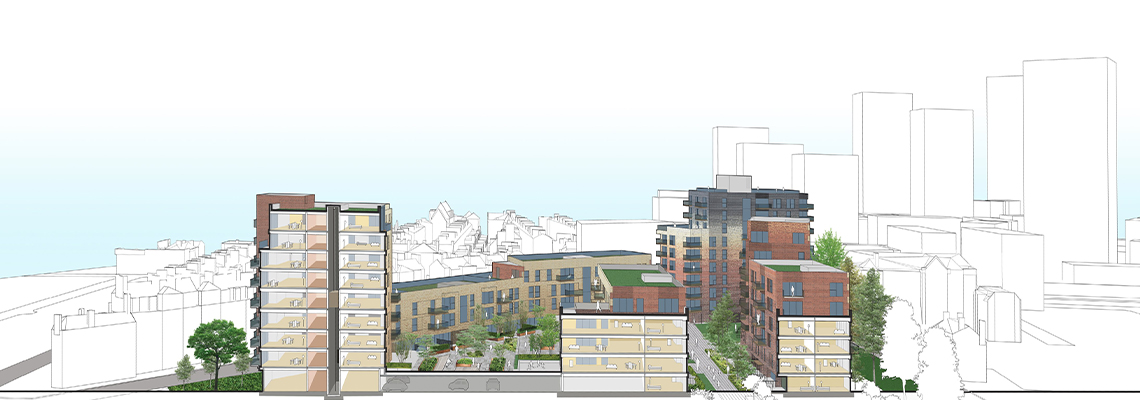


235 high-quality apartments, transforms 1960’s mega blocks and reconnects with the 19th-century fabric of the neighbourhood.
Our partners, Lendlease completed Trafalgar Place as the 1st phase of the London Borough of Southwark's £3bn Elephant and Castle regeneration. The development provides 235 high quality homes within seven apartment buildings, two of which are constructed from Stora Enso's Cross Laminated Timber (CLT).
Designed by multi-award winning architect De Rijke Marsh Morgan (dRMM) and installed by specialist timber engineer Eurban, Trafalgar Place provides 5,000 new and replacement homes along with a pedestrianised town centre and market square, new public transport hub and five green open spaces.
Specification
CLT was specified for the development as a means of providing a sustainable housing solution and to limit the long term environmental impact of the development, both of which were key considerations for Lendlease and dRMM. The CLT superstructures of these buildings were constructed in just six weeks, a clear benefit in terms of the construction programme
Location
Situated in the very heart of London, Elephant and Castle is home to a large and diverse community. The area started life as two prosperous villages, Walworth and Newington, and by the 1890s had become known as 'the Piccadilly Circus of South London' boasting many of the City's major music hall theatres and attracting leading performers of the times. However, following the Second World War much of the area lay in ruins and subsequent rebuilding was of poor quality comprising huge impersonal structures such as the shopping centre, Heygate Estate and the Northern Roundabout which left it struggling to adapt and grow.
Urban redvelopment
The overall plan for the redevelopment of the Heygate Estate aims to restore the area to its former glory as a thriving, desirable place to live and visit. At an urban level, Trafalgar Place seeks to reconnect the adjacent neighbourhood by reinserting an historic street pattern through the centre of the site. Paragon Walk is a pedestrianised thoroughfare that connects the surrounding community and around which the rest of the development is arranged. Seven apartment buildings are arranged across the site, with a stepping massing that takes reference from the various heights of the surrounding context.
Taller buildings are located to the north-west of the site and at the south as a place marker to the southern entrance to the masterplan. The development is characterised by its setting in an established landscape. The design and siting of the buildings allows for existing trees to be maintained wherever possible and in total 46% of the ground level is provided as publicly accessible landscape which is divided into a number of character areas including a woodland walk to the north, café spill-out seating to the south and a quiet reflection garden opposite the vicarage to the east. CLT was considered early in the design stages as a means of providing a sustainable housing solution.
Construction
The on-site benefits of CLT which include prefabrication, accuracy, speed and ease of erection and enhanced thermal and air tightness performance all contributed to its selection over other traditional methods of construction. In addition to the material's sustainability benefits, CLT offered clear programme benefits and provided a cleaner site, pleasant workplace and the prefabricated panels cut to factory tolerances allowed for high quality finishing. Innovative features at Trafalgar Place include the extensive SUDS system which collects rainwater from the roofs of the buildings and stores it within a blue roof system on a raised communal terrace.
This collected water can be used for irrigation or drained through a fountain into a water feature before finally filtrating into the groundwater via a swale that lines one side of Paragon Walk, the central pedestrian thoroughfare. Externally, the façade brickwork of the CLT constructed buildings is designed to reference the surrounding context. In total nine brick types are used and arranged in a graduating pattern that mimics the material colours of the adjacent Peabody Estate buildings on Rodney Road.
London based international design-led dRMM is renowned for its work with wood architecture, has a long history of innovation in building projects that include CLT. It was amongst the first in the UK to use the material and the use of engineered timber is encouraged throughout the practice as a means of reducing the carbon footprint of buildings whilst enhancing the internal characteristics of its projects.
Awards
Stirling Prize Shortlist (2016) - This is one of the most prestigious architecture awards in the UK
Development of the Year at the British Home Awards (2016)
Mayor's Award for Planning Excellence at the London Planning Awards
London Tree and Woodland Award (2018)- Recognized for its environmental contributions
Residential Multi-storey Building Concept by Stora Enso Multi-storey buildings in massive wood are high-performing, renewable structures that can help to meet the growing demand for new urban buildings and more efficient, sustainable construction. Click here to learn more about our residential multi-storey building concept.
| Area (m²) | 16,660 |
| Storeys | 7 |
| Units | 235 |
| Products and Services | Sylva™ CLT Floors and Roofs, Sylva™ GLT Beams and Columns |
| Product quality | Non visible quality (NVI) |
| Product volume (m³) | 625 |
| Product delivery duration (weeks) | 11 |
| Number of deliveries | 13 |
| Partner of Stora Enso | Lend Lease |
| Developer | London Southwark Council |
| Architect | dRMM |
| Structural Engineer | Robert Bird Group |
| MEP Designer | Wallace Whittle / Tuv Sud |
| Main contractor | Lendlease |
| Specialist Timber Subcontractor | Eurban |